So, sometimes when there's tons of hype surrounding a book, I'm tempted to automatically discount it. It can't be THAT good right?
So I'd heard Paranormalcy by Kiersten White was funny. I'd heard Evie, the teen heroine, used a pink sparkly taser to "bag and tag" vampires. I'd heard the book poked fun at the whole paranormal romance genre.
Guess what? The peoples on the interwebs were right!
One quick stop at Kiersten White's amazing blog will confirm that this chick is funny. Paranormalcy has the same light-hearted tone as White's blog, which is awesome.
Paranormalcy reminded me of the movie Clueless, in a way. The main character and plot seem very superficial at first. But it's written so intelligently that you can't help but laugh and root for the heroine as she learns to be less selfish and discovers something deeper about herself and about life.
I loved how White threw in a few jabs at YA vampire romances. The opening scene is hilarious as Evie tases a vamp and rants about how ridiculous it is that vampires think they're sexy. She even uses the word "shimmery" to describe a vampire in an ironic way and I couldn't help but think of that as a direct poke at a certain franchise. I also loved when, towards the end of the book, a vampire tells Evie, "Why on earth would a vampire go to high school?" Hilarious!
The romance is so sweet and refreshing. There was no I-love-you-but-kind-of-want-to-kill-you, No I-love-you-but-our-love-will-probably-destroy-the-universe, and No I-love-you-but-I'm-so-damaged-from-my-hundred-year-old-past-so-I'm-really-mean-to-you.
It was more like, I-really-like-you-I-hope-your-dad-doesn't-catch-us-making-out-on-the-couch and then some I-think-I-love-you-but-I hope-you-accept-me-for-who-I-am-with-all-my-weirdness.
White shows us that we can have a paranormal novel with NORMAL teens. We can read about teens who get grounded, love shopping sprees, eat pizza, and go to prom. They also happen to have paranormal abilities and, you know, murderous faeries hunting them.
If you love paranormal romaces, or hate them, read Paranormalcy. You won't be disappointed.
I can't wait for Supernaturally!
Where I rant about my drug of choice: YA books with strong female protagonists.
Saturday, September 25, 2010
Saturday, September 11, 2010
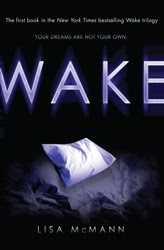
Janie does it in her sleep in WAKE by Lisa McMann
Like any good addict, I have crazy dreams. I fly, I swim, I bounce around from place to place. I was a little disappointed with Inception and how normal the dreams were.
In Wake by Lisa McMann, Janie is sucked into people's dreams. I loved the lyrical style of the book, especially the beginning when we slip in and out of people's dreams with Janie. Our dreams can be very intimate and revealing, but McMann didn't hold back in describing the sleeping images flashing through teenagers' heads.
I also enjoyed the love story. Cabel is my new literary crush, who knew scars could be so sexy?
I really enjoyed the first half of the book. But the second half started becoming too unbelievable for me.
SPOILER ALERT!
I just didn't buy that Cabel was an undercover teenage cop. The way that was handled came across as very unbelievable to me. Sure, I can believe a girl can slip into someone's dreams and control them, but I can't believe law enforcement would behave that way.
But the well written dream sequences and the realistic romance were enough for me to enjoy Wake.
The sequel, Fade, on the other hand is a different story. As a high school teacher, I can be very picky about the way high school is portrayed in YA. High schools are already dramatic conflict-flled places, we don't need over-the-top and outlandish crimes to be committed in order for teenagers to experience conflict and feel unsafe.
I thought Fade was completely unrealistic. I get it, it's a fantasy, but if the story is based in the real-world, I need something real in that world to hold on to.
There are teachers who do horrible things. We didn't need the over-the-top, sensationalized villainy in order for Janie to be in danger. I think the story would've been scarier if the high school setting was more realistic.
I also didn't buy the conflict between Cabel and Janie. It wasn't consistent with Cabel's character and teenagers aren't usually that cognizant of their feelings and why they behave the way they do.
I liked Wake, but was disappointed with Fade. I won't be reading Gone unless someone convinces me it has at least one foot in reality.
Labels:
dream,
Fade,
Gone,
Lisa McMann,
love story,
review,
Wake
Friday, September 3, 2010
Cat Killer?
OK Junkies, I need some help. I'm stuck. All because of a cat corpse.
At our last meeting, my critique group hated the chapter I'd submitted. I've never received such a negative response. You see, in the chapter they read, a little girl accidentally kills her cat.
"You can't kill a cat!" They shouted.
"Do you have to describe the cat corpse?" They asked.
"Really? A dead cat? You really want to do that?"
I didn't understand. What's the problem? That same night we read about dead grandmothers, suicidal rock stars, and murdered scientists. Why couldn't I have a dead cat?
They informed me that people will hate me and hate my book if I kill a cat. This seemed to be a basic rule of good craft everyone knew but me. Show, don't tell. Omit needless words. No passive voice. And don't kill any cats.
Basically, by killing a cat, I was killing my writing career. They told me there's even a book on screenwriting called Save the Cat! The book states that all you have to do to sell your screenplay is not kill any cats. (I haven't read the book, but I'm pretty sure that's what it says).
I tried not to get defensive. I tried to listen to their feedback, to process it, to see which direction my revisions should take. And then I realized it. I kill TWO cats in my WIP. (And a baby bird, but I'm sure there's no rule on baby birds).
Well, I decided to stick to my guns. I blew off the advice of my critique group. They're probably all just crazy cat people or something.
Then I went to another meeting, with a different group of writers. We discussed the atrocities of dead dogs in children's literature.
One writer even talked about an appalling scene in an adult novel. She mentioned an extremely popular adult trilogy. "I almost had to stop reading when they killed the cat! It was just awful!"
I happened to have recently read the book she was talking about. You mean the same book where the main character is raped and tortured in a graphic scene that has NOTHING to do with the plot? You mean the same novel where dozens of women are raped and murdered, but the characters are more concerned about the Swedish stock-market? You almost stopped reading because of the dead cat?
What's wrong with these people?
Then last week, I read Mockingjay. SPOILER ALERT!

Of all the characters Collins killed, she saved the cat. Buttercup survived. Maybe there's something to this Save-the-cat theory. After all, Rowling killed Hedwig but spared Crookshanks.
END SPOILER
It's not like I'm some sadistic animal hater. My dog and my cat are my only children. I'm a freakin' vegetarian! I don't eat animals, I just kill them in my fiction (but for important plot and character reasons, I totally swear.) I just don't get why people seem to be more sensitive to the death of animals than to the death of humans in fiction.
So what do you think Junkies?
Do you hate books with dead cats?
Can anyone explain this never-kill-a-cat rule?
Is my WIP doomed if I kill a cat? If I kill two?
Could I change my dead cats to dead dogs? dead babies?
Well, I might keep my dead cats because when the rejections for my MS start rolling in, at least I can blame it on the dead kitties, right?
*photo from here
Sunday, August 29, 2010
Some spoiler-free thoughts on Mockingjay by Suzanne Collins
So, I feel like I can't really do Mockingjay justice in a review, and I don't want to give away any spoilers. And more than writing a review, what I really need is a freakin' therapy session after that speed train of emotion.
I think Mockingjay is by far the best book in Suzanne Collins's Hunger Games trilogy. The three books ask: what does it do to us when we kill another person, even in self-defense? The Hunger Games touched on this theme, Catching Fire pushed it a little further, but Mockingjay blew it wide open.
As another character points out, Katniss is not the same girl who volunteered to take her sister's place at the reaping. She's permanently and irrevocably scarred by the violence she's experienced and produced. What I love is that even though she has nightmares and is sometimes "disoriented" she is in no way a victim. Katniss is traumatized not by what's been done to her, but by the choices she's made. I don't think she regrets any life she took to save herself, but that doesn't mean she sleeps well at night.
All the Victors are a wreck. I love how in the beginning of The Hunger Games, Katniss views Haymitch as this pathetic creature who hides from life in the bottom of a bottle. In Mockingjay, Katniss and Haymitch don't seem very different, Katniss even wishes for her own bottle at one point.
I thought Peeta's character arc was brilliant. So much more heartbreaking than a typical love-triangle or the who-do-I-save dilemma I thought it was going to be.
I know some people are disappointed with the ending, but frankly I think those are the same people who are disappointed with life. Collins's world and Katniss's story are so devastating because they are so real. Collins doesn't pull any punches. Katniss is, above everything else, a survivor. And just like President Snow, Collins pushes Katniss to her breaking point.
I white-knuckled it, holding on with Katniss through her harrowing journey, not knowing what to even hope for at the end. But some damage cannot be undone. We still pick up the pieces and salvage what we can of our lives. If reader's don't like Mockingjay's ending it's because it's too true.
The story is so critical of war and vengeance that I cried not just for the characters, but for humanity. We sacrifice our children to overthrow dictators, only to replace them with more dictators. We kill a few to save the many, over and over, and over again until we can't remember who we're saving and who we're fighting.
This book is amazing, but it drained me. What are your thoughts? Anything light and fluffy to recommend for recovery reading?
Labels:
Hunger Games,
Katniss,
kick-ass heroine,
Mockingjay,
review,
Suzanne Collins
Tuesday, July 20, 2010
Claudia is ruthless in INCARCERON by Catherine Fisher
OK Junkies, I'm bending some of my own rules here. Incarceron by Catherine Fisher has two main characters. The story is alternately narrated by Claudia and Finn. Sure, Claudia is the heroine of the story, but it's hard for me to focus only on her when Finn is so much more likable.
Claudia and Finn are each trapped in prisons that are worlds apart.
Three years ago, Finn woke in a cell with no memory of his previous life and the red eyes of Incarceron have been watching him ever since. Finn has seizures in which he glimpses a world outside of the living prison. Other prisoners call him a starseer and most consider him crazy. Incarceron is limitless in its mechanization and ability to control the prisoners while reproducing itself. Most prisoners know what Finn refuses to admit: there is no world outside of Incarceron.
Claudia's father is the power-hungry and unscrupulous Warden of Incarceron. The prison was sealed years ago, no one goes in and no one comes out. The Warden is the only person who knows its location. Despite the existence of advanced technology, Claudia's world has been frozen in time and Protocol is strictly enforced. The rules of Protocol dictate everyone must speak, dress, and use objects from a time reminiscent of Victorian England.
But Protocol is only one bar in Claudia's prison. Her father raised her to be a political pawn. She's betrothed to a prince and the Warden will use his daughter to secure power. At first, Claudia accepts her part to play in the political game. She is so used to hiding her true feelings and playing mind games, that she forgets who she is.
Even though Finn is the thief and violent gang-member, Claudia is the ruthless one and she strays farther from her moral compass. I couldn't help but like Finn so much more.
This story read like a wicked fairy-tale. It's Rapunzel, the Prince and the Pauper, and Alice in Wonderland all rolled into one.
Catherine Fisher does a brilliant job of creating tension in each scene as Claudia and Finn discover each other and work towards what seems impossible: Escape. Finn's prison is terrifying as is the Queen Claudia works to subvert. I ended each chapter with my heart pounding. The shackles squeezed tighter and tighter with each scene and escape seemed less and less possible.
The ending was a little disappointing. After all the nail-biting tension, I feel like it just kind of fizzled out. But that's probably because there's going to be a sequel.
Incarceron is a dark and intense ride and I can't wait for Sapphique.
Labels:
Catherine Fisher,
fairy-tale,
Incarceron,
prison,
review
Subscribe to:
Posts (Atom)